“Sorry for the inconvenience” is the apology a store sends when nobody has decided what it’s sorry for. The parcel is four days late, the customer has written twice, and the reply names neither the delay nor the fix. It reads as a brush-off because, most of the time, it is one.
This guide covers what the phrase means, why customers hear it that way, and a three-part replacement that works in any channel: name what went wrong, own it, say the next step. The 15 alternatives are grouped by the situations an ecommerce support team sees most, the five email templates come with subject lines, and one section covers when to skip the apology and fix the problem instead. If the customer is already angry, start with how to handle customer complaints, then come back for the wording.
What “sorry for the inconvenience” means
The phrase acknowledges that something on your side cost the customer time or money, without saying what. “Inconvenience” is a deliberately small word: a detour, or a form filled in twice. That’s why it suits a sign on a closed lift and fails in a reply about a damaged order.
Spelling trips people up more than meaning. It’s i-n-c-o-n-v-e-n-i-e-n-c-e; the usual slips are “inconvinience” and “inconvience”. The longer variant, “sorry for the inconvenience caused”, is grammatical but adds a word without adding information. If you use either, follow it with a sentence that says what you’re doing about the problem.
Why customers hear it as a brush-off
A customer who writes in already knows something went wrong. What they’re checking is whether you know, and whether you plan to do anything. The phrase fails both tests, for five reasons that keep showing up in frustrated customer emails:
- It sounds canned: everyone has read it a hundred times, so it registers as a script rather than a person.
- It doesn’t name the problem: a customer whose gift arrived after the birthday wants to hear “the birthday”, not “the inconvenience”.
- It centers on you: “sorry” describes your feeling. The customer wants their experience described.
- It shrinks the problem: a $900 TV delivered in pieces is not an inconvenience. Calling it one tells the customer you haven’t looked.
- It says nothing about what happens next: an apology with no next step is a closed door with a polite sign on it.
One example from my own inbox. A billing error at my internet provider took ten days and four calls to fix. The closing email said “sorry for the inconvenience” and nothing else: no credit, no name, no line about what had changed. After four years as a customer, I switched the next month. The fix was fine; the apology lost them the account.
The three-part apology: name what went wrong, own it, say the next step
Every alternative in this post follows one formula: name what went wrong, own it, say the next step. Three sentences is usually enough, and the order matters less than having all three.
- Name what went wrong: be specific, down to the order number and the day. “Your order #4821 shipped three days late” beats “the delay with your order”.
- Own it: “That’s on us”, with no “but”, no “unfortunately” and no weather report. If a carrier lost the parcel, you still chose the carrier.
- Say the next step: what you’ve done, what happens next and when. A ship date, or the day a refund lands.
In practice, the third part is the one teams skip and the one customers reread. “We’re looking into it” leaves them to write again tomorrow; “I’ll email you by 3 pm Thursday either way” lets them stop thinking about it. Frames like “please accept my apologies” are fine as a wrapper; they only become a generic apology when the three parts are missing around them.
15 better ways to say “sorry for the inconvenience”, by situation
Each line below follows the formula: name what went wrong, own it, say the next step. Swap in your own numbers and dates. The structure holds in email, live chat and a WhatsApp reply.
Shipping delay
1. Your warehouse missed the date: “Your order #4821 should have shipped on Tuesday and didn’t. That’s on us. It leaves today by express at no charge, and I’ll send tracking by 5 pm.” Use it when the miss is yours. It names the day, takes the blame and gives a time the customer can hold you to.
2. The carrier is running late: “Your parcel has sat at the carrier’s depot since Thursday, longer than we accept. I’ve opened a trace and will have an answer by tomorrow; if it hasn’t moved by then, we ship a replacement.” Use it when tracking has stalled. It owns the choice of carrier without pretending you drive the van.
Wrong item
3. Wrong item, low value: “You ordered the navy medium and we packed the black large. Our mistake. The right one ships today, and you can keep or donate the black one; no need to send it back.” For anything not worth the return postage. The customer was dreading a chore, and this removes it.
4. Wrong item that needs to come back: “We sent you the wrong lens, a packing error on our side. I’ve attached a prepaid label, and the correct lens is already on its way, so you’ll have it before the courier collects the other.” Use it when the item is too expensive to write off. The replacement leaves before the return arrives.
Damaged on arrival
5. Damaged in transit: “Your photos show the frame cracked through the corner, which means our packaging failed, not you. A replacement ships tomorrow in a double-walled box, and I’ve refunded the shipping.” Use it once the customer has sent a picture. The blame lands on the box, not on them or the courier, and the message says what’s different next time.
6. Damaged, and you can’t replace it: “The mug arrived broken, and I’m sorry for the bad experience. We’re out of stock on that design, so I’ve refunded the full amount today; it reaches your card within five business days.” Use it when a replacement isn’t possible. It’s honest about the stock and specific about the money.
Refund taking too long
7. Refund promised, not yet processed: “I said your refund would go through by Monday and it didn’t. That’s my miss. I’ve processed it now; the $64 shows on your statement within three to five business days, and I’ll email when it clears.” Use it when the delay is yours. It owns a broken promise instead of describing “a delay”.
8. Refund processed, slow to show: “Your refund went through on the 2nd. The bank holds it for up to seven working days, which I should have told you up front. If it isn’t there by the 11th, reply here and I’ll chase it with a reference number.” Use it when the money is already moving. It gives the customer a date and a trigger.
Oversold or out of stock after the order
9. The stock count was wrong: “We sold more of the oak shelf than we had, and your order was one we couldn’t fill. That’s a stock-count error on our side. You can wait for the 14 October restock with 15% off, or take a full refund today; tell me which.” Use it when inventory overstated stock. It explains the cause in one clause and hands over the choice.
Site or checkout down
10. Checkout failed during a sale: “Checkout was down for 40 minutes last night, in the middle of the launch, and it locked you out. The site is back, your cart is saved, and I’ve applied the launch price so you don’t lose the discount.” For the customer who couldn’t pay. What they lost was the launch price; the page coming back is the easy part, so this gives the price back too.
Long wait on chat or email
When the wait is the problem, the apology itself is late. Lead with the answer, then own the gap; our guide to how fast you should respond has the benchmarks.
11. Long wait on live chat: “You waited 22 minutes for a reply on chat today, far longer than we aim for. That’s on our staffing, not on you. I have your question here, so let me answer it now.” Use it the moment you pick up. It names the number, then does the job instead of apologizing twice.
12. Email left unanswered: “Your message from Monday sat in our queue for three days without a reply. There’s no good reason for that. Here’s the answer: [the answer]. If anything else is open, reply here and it comes straight to me.” Use it when a conversation slipped. It leads with what the customer has been waiting for.
Billing error
13. Overcharged: “We charged you $84 instead of $48 on order #5120. The discount code didn’t apply at checkout, which is our bug, not your typing. I’ve refunded the $36 difference today, and the code is fixed.” Use it when the amount is wrong. It states both numbers and leaves no doubt whose fault it was.
14. Charged twice: “Your card was charged twice for the same order, which should never happen. I’ve reversed the duplicate and flagged the gateway so it doesn’t recur; you’ll see the reversal within three business days.” For a payment that retried. “Should never happen” owns the severity, and the next step has a date.
Rude or wrong answer from a teammate
15. The last reply was wrong, or short with the customer: “The answer you got yesterday about our returns window was wrong: it’s 30 days, not 14, and you’re inside it. I’m sorry we told you otherwise, and sorry for the tone. I’ve approved your return and attached the label.” Use it when you’re picking up after a colleague: it corrects the record and makes the fix in the same message. Leave a private note so the coaching happens inside the team, not in front of the customer.
Quick reference: what to say and what to do next
One row per situation: the opening line, and the next step the customer should hear in the same message.
| Situation | Opening line | Next step |
|---|---|---|
| Shipping delay | Your order should have shipped Tuesday and didn’t. That’s on us. | Express reshipment at no charge, tracking by a stated time |
| Wrong item | You ordered the navy medium and we packed the black large. | Correct item ships today; keep or return the wrong one with a prepaid label |
| Damaged on arrival | Your photos show the corner cracked in transit, so our packaging failed. | Replacement in sturdier packaging tomorrow, shipping refunded |
| Refund taking too long | I said the refund would go through Monday and it didn’t. That’s my miss. | Processed now, with the date it lands and a reply trigger if it doesn’t |
| Oversold after the order | We sold more than we had, and your order was one we couldn’t fill. | Restock date with a discount, or a full refund today, customer’s choice |
| Checkout down | Checkout was down for 40 minutes last night and locked you out. | Cart saved, launch price applied, site confirmed back |
| Long wait | You waited 22 minutes on chat today, far longer than we aim for. | The answer, in the same message |
| Billing error | We charged you $84 instead of $48 because the code didn’t apply. | Difference refunded today, code fixed |
| Wrong or rude answer | The answer you got yesterday was wrong, and I’m sorry for the tone. | Correct answer and the fix, applied immediately |
Five email templates for the apologies you send most
Each template is short enough to send from a phone and uses the same three parts. Store them as saved replies with merge variables for the name and order number, and edit the line that names what went wrong before you send. Our guide to canned responses covers keeping a library like this fresh.
1. Shipping delay
Subject: Order #4821 is late, and here’s the new date
Hi Maya,
Your order should have shipped on Tuesday and it didn’t. That’s on us, not the carrier. It left this morning by express at no charge; tracking is below, and the new delivery date is Thursday. If it doesn’t arrive by then, reply here and I’ll refund the shipping and start a trace.
Priya, Oakline support
2. Wrong item
Subject: We packed the wrong item, and the right one is on its way
Hi Tom,
You ordered the navy medium and we sent the black large. That’s a packing error on our side. The navy medium ships today, with tracking to follow. Keep the black one, pass it on, or drop it at any return point with the attached label, whichever is easiest. I’m sorry for the mix-up.
Priya, Oakline support
3. Damaged on arrival
Subject: Your frame arrived broken, so a replacement ships tomorrow
Hi Elena,
Thanks for the photos. The corner cracked in transit, which means our packaging wasn’t up to the job. A replacement ships tomorrow in a double-walled box, and I’ve refunded your shipping charge. No need to return the damaged one.
Priya, Oakline support
4. Refund delay
Subject: Your refund is processed, with the date it will show
Hi Sam,
I told you the refund would go through on Monday and it didn’t; that was my miss. I’ve processed it now: $64 back to the card ending 2211, which usually shows within three to five business days. If it isn’t on your statement by the 14th, reply here and I’ll chase it with the bank using the reference below.
Priya, Oakline support
5. Billing error
Subject: We overcharged you by $36, and it’s refunded
Hi Jordan,
The discount code didn’t apply at checkout, so we charged you $84 instead of $48 on order #5120. That’s a bug on our side, and I refunded the $36 difference today. The code is fixed, and I’ve added it to your account so it works on your next order. Thanks for catching it, and I’m sorry for the extra step.
Priya, Oakline support
When not to apologize
Three cases come up every week where an apology makes the message worse.
Apologize or solve: if the customer asked a question, answer it. An apology in front of an answer they’re still waiting for reads as a delay. Solve first, and apologize in the last line only if an apology is owed.
The minor issue: a typo in a tracking email, or a knowledge base article one version behind. Fix it and say so in one plain sentence: “fixed, thanks for flagging it.” A formal apology for a small thing tells the customer it was bigger than they thought.
When you can’t fix it yet: don’t apologize for an outcome you don’t have. Commit to the next update instead: “I don’t have an answer yet. I’ll email you by 3 pm tomorrow either way.” A kept promise about timing repairs more trust than any wording.
Common mistakes
Most apologies that go wrong aren’t cold; they’re padded. Each pattern below has a one-line fix.
- Apologizing twice in one message: once at the top, once at the bottom, and the second buries the next step. Apologize once, then act.
- “But” and “unfortunately”: every word after “but” undoes the words before it. “I’m sorry, but our policy” is a refusal with a bow on it.
- Blaming the carrier, the system or the weather: the customer bought from you. Own the choice, then explain the cause only if it helps them.
- Compensation as a reflex: a 10% code on every apology teaches customers to complain for codes and costs margin on the ones who didn’t need it. Offer it when the customer lost money or time you can measure.
- No name at the bottom: “The Support Team” is the signature of a company that doesn’t want to be reached. Sign it, and mean the reply-to.
How ThriveDesk handles apologies at scale
An apology that follows the formula takes a minute to write and five seconds to send, once the pieces are in place. ThriveDesk gives a two-person store team those pieces from the first week.
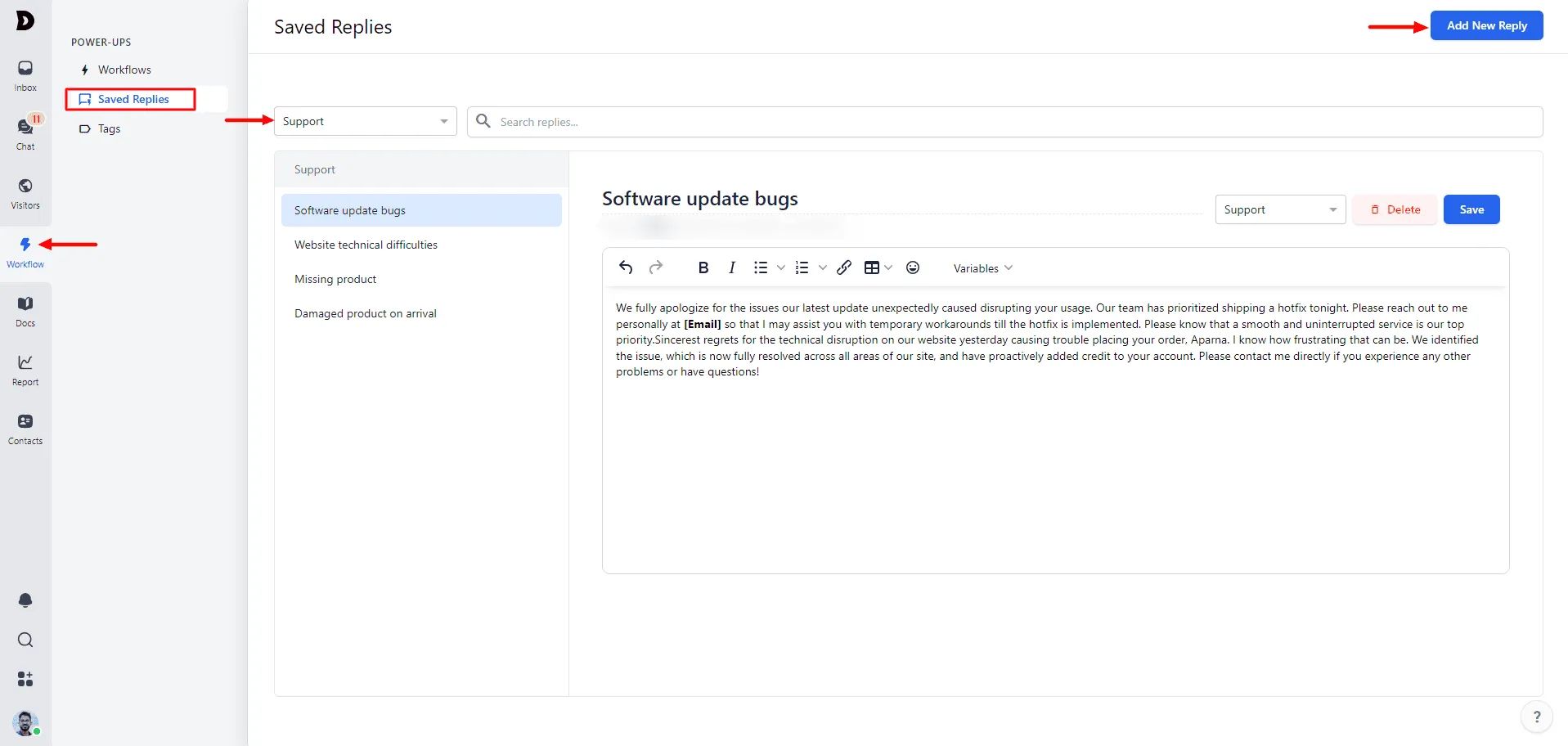
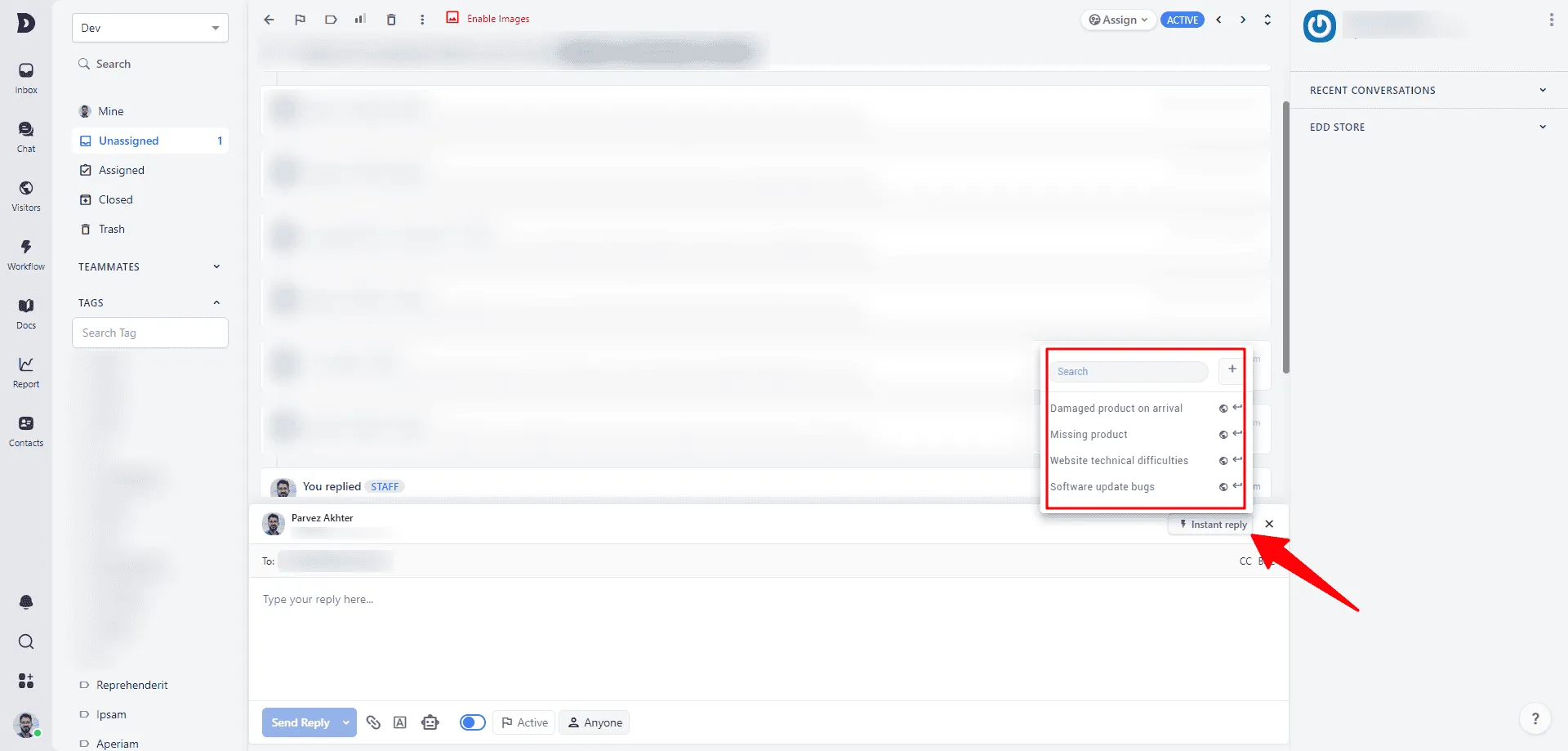
Saved replies with merge variables: one apology per situation lives in the inbox’s library. In the reply editor, type “/” or click “Instant reply”, pick “Shipping delay”, and the customer’s name and order number fill in from the conversation. Edit the line that names what went wrong, then send. To build the library, open Workflow in the left-hand panel, choose Saved Replies, pick the inbox, and click “Add New Reply”.
Order details beside the conversation: with the WooCommerce integration, the order number, ship date and items sit next to the message, so “name what went wrong” needs neither a second tab nor a question back to the customer. The merge variables pull from the same data.
One shared inbox, so nobody apologizes twice: a shared inbox with assignments shows who already replied, and private notes keep the “I’ll take this one” inside the team, so the double “sorry again” from two people answering the same email stops.
Workflows catch the conversations that need one: automation rules route, tag and assign, so a “where is my order” message lands with the person who can see the shipment, and a refund request with the person who processes it. The apology goes out with the fix, not ahead of it.
Plans start at $29 a month for two teammates and one inbox, with no per-seat charge; the pricing page lists the rest. The 7-day trial doesn’t need a card.